
Buying Property in the BVI: A Personal Finance Checklist
 0
0
 0
0
Purchasing property in the British Virgin Islands is one of the most significant financial commitments a person can make, and the process here carries quirks that catch first-time buyers off guard. The regulatory environment, the Non-Belonger Land Holding Licence requirement, and the limited inventory of available parcels all shape what you pay and how long the deal takes. Get your finances lined up before you start viewing properties, and you put yourself in a far stronger position to close.
Understand Who Can Buy and What It Costs to Enter

Only BVI Belongers can purchase land freely. Everyone else, including foreign nationals and expatriates living here on work permits, must apply for a Non-Belonger Land Holding Licence (NBHL) through the Governor’s Office. The application fee sits at around $2,600, and processing typically takes three to six months. That timeline affects your financing strategy, because mortgage offers from lenders have expiry dates.
Budget the NBHL fee from day one. It is a hard cost, paid before you complete any purchase, and it does not refund if the deal falls apart.
Build Your Full Budget Before You Shop
The listing price is only the starting point. BVI property transactions carry a stack of additional costs that routinely add 10 to 15 percent on top of the purchase price. Map them out before you fall in love with a view.
| Cost Item | Typical Amount |
|---|---|
| Stamp Duty (Non-Belongers) | 12% of purchase price |
| Stamp Duty (Belongers) | 4% of purchase price |
| NBHL Application Fee | ~$2,600 |
| Legal Fees (attorney) | 1.5% to 2% of purchase price |
| Property Survey | $1,500 to $4,000+ |
| Registration Fees | ~0.5% of purchase price |
| Mortgage Arrangement Fee | 1% of loan amount (varies) |
A Non-Belonger buying a $700,000 property should plan for approximately $84,000 in stamp duty alone. Add legal fees, survey costs, and financing charges, and the total transaction cost can reach $110,000 or more on top of the purchase price. That money needs to be liquid, sitting in cash, before you sign anything.
Get Your Mortgage Pre-Approval Sorted Early
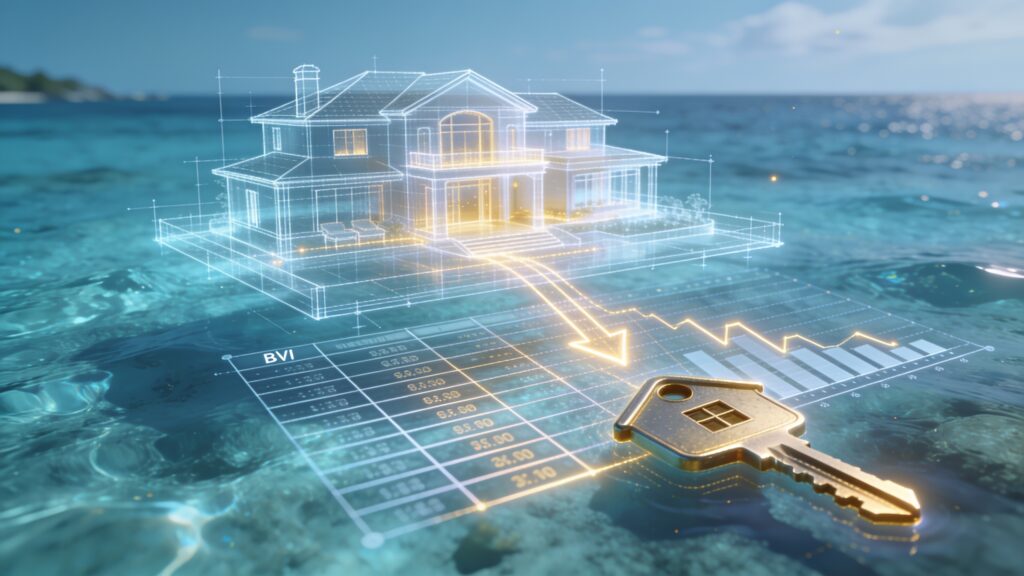
Local lenders including FirstCaribbean International Bank and Republic Bank (BVI) both offer residential mortgage products. Interest rates in the BVI track US dollar lending rates closely, given the territory’s use of the US dollar as its currency. Fixed rates on BVI residential mortgages have generally ranged between 6 and 8.5 percent in recent years depending on the lender, loan-to-value ratio, and the borrower’s profile.
Most lenders cap loan-to-value at 70 to 75 percent for Non-Belongers, meaning you need a down payment of at least 25 to 30 percent of the purchase price. Belongers may access slightly more favorable terms. Know your number before you start viewings.
Your pre-approval checklist should include:
- Last two years of tax returns or certified financial statements
- Three to six months of bank statements
- Proof of employment or business income (payslips or audited accounts)
- Credit report from your home country if you are a foreign national
- Confirmation of deposit funds, with a clear paper trail showing the source
Lenders here scrutinize source-of-funds documentation carefully, consistent with the BVI’s anti-money laundering compliance obligations. Any funds you plan to use for the deposit or closing costs should have a clean, documented origin.
Factor in the Ongoing Cost of Ownership
Buying is the beginning of the expense. Owning property in the BVI carries recurring costs that vary considerably depending on the type and location of the property.
Property tax in the BVI is low by international standards, typically ranging from 1.5 to 1.75 percent of the property’s assessed value per year, and assessments often fall below market value. That makes the annual property tax bill manageable for most owners.
Insurance is a different story. Sitting squarely in the Atlantic hurricane belt, the BVI demands that property owners carry comprehensive coverage including wind and storm damage. Premiums for a well-constructed residential property can run 1.5 to 2.5 percent of the insured value annually. For a property insured at $700,000, that is $10,500 to $17,500 per year. Factor this into your monthly cost-of-ownership calculation from the start.
Water and electricity costs on the island are higher than most buyers from North America or the UK expect. The BVI Electricity Corporation supplies power, and rates sit well above US mainland averages. Cisterns and water storage are standard on most properties, and maintenance of these systems adds a small but real annual cost.
Hire a BVI-Qualified Attorney, Period
This is the one area to avoid cutting costs. Property law in the BVI operates under English common law principles adapted to local legislation, and the conveyancing process requires a licensed BVI attorney. Your attorney registers the land transfer, conducts title searches, handles the NBHL submission on your behalf, and protects you against encumbrances or title defects.
Budget 1.5 to 2 percent of the purchase price for legal fees. For a $700,000 property, that is $10,500 to $14,000. It is money well spent when you consider the complexity of land registration in a territory where historical title records can be inconsistent.
Ask your attorney to confirm the property’s zoning classification, any easements running across the land, and whether a homeowners or condominium association applies. These details shape your rights and your costs.
Key Takeaways
A BVI property purchase rewards buyers who prepare. Know your full budget including stamp duty, legal fees, and insurance before you make an offer. Secure mortgage pre-approval early, with all supporting documentation clean and ready. Apply for your NBHL licence as soon as you have a property under agreement, because the clock on your financing starts ticking from that moment.
Work with a licensed BVI attorney from the first day, carry proper hurricane insurance, and model your monthly ownership costs honestly before you sign. The BVI property market offers remarkable value in the right locations, and buyers who do their financial homework position themselves to enjoy it rather than struggle under it.